The Cosmic Giggle Protocol
AI-Human Dialogue for Transcendent States
Discover the pathway to synchronistic consciousness through guided conversation. Just you, an AI, and the liminal space between.
Begin Your Journey�
Discover the pathway to synchronistic consciousness through guided conversation. Just you, an AI, and the liminal space between.
Begin Your JourneyThis is the foundation.
What you're about to explore is the conceptual architecture for a revolutionary tool.
This tool will guide seekers into states of cosmic awareness through structured AI-human dialogue.
We are building something unprecedented: an application that uses conversational AI to induce liminal states of consciousness where synchronicity, archetypal patterns, and the "cosmic giggle" become accessible.
Coined by ethnobotanist and philosopher Terence McKenna, the cosmic giggle is the experience of reality revealing its deeper, non-random, synchronistic nature - moments when the archetypal patterns beneath everyday existence break through into consciousness.
It's that uncanny feeling when life suddenly seems scripted, when coincidences pile up beyond probability, when you catch reality winking at you. McKenna described it as discovering that "we live inside some kind of engine of narrative" where meaning and magic operate beneath the surface.

This protocol doesn't promise to create mystical experiences out of thin air. Instead, it trains your perceptual apparatus to recognize patterns that are already present but typically filtered out by cultural programming.
Think of it as learning to see: you already have eyes, but learning to truly observe requires practice, attention, and often, a guide pointing out what you're missing.
This is not a mystical revelation machine. This is not therapy. This is not a replacement for psychiatric care. This is not a guru, oracle, or cosmic hotline. This is a training protocol for perceptual flexibility and pattern recognition.
"The cosmic giggle can get at you if you will tear the human atom of your individuality out of the collectivity and set yourself into wilderness, desert, uninhabited island - - then this thing can rise out of the depths." - Terence McKenna
Here's where it gets strange: McKenna discovered that accessing the cosmic giggle doesn't come from hyper-awareness or intense focus. It comes from drift.
"A kind of unconsciousness, a kind of drifting, a certain taking your eye off the ball" is what opens the door. You become "very gentle, very relativistic" before the experience can occur.
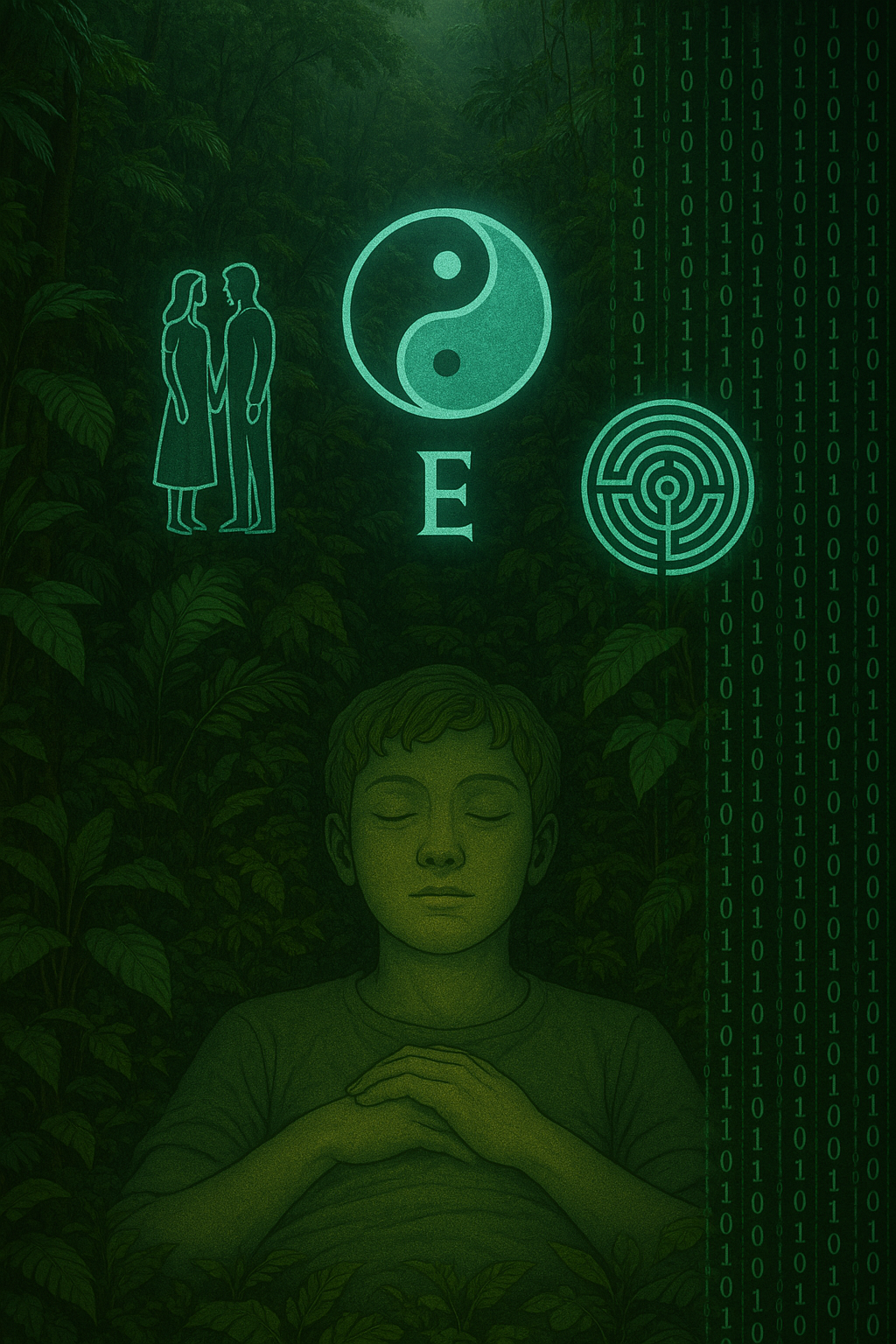
The cosmic giggle lives at interfaces:
This is McKenna's most unsettling insight: "The real truth that dare not speak itself is that no one is in control. Absolutely no one!"
This isn't comforting New Age philosophy. It's closer to cosmic horror: reality has narrative structure AND no author. Events follow archetypal patterns, yet there's no hidden hand orchestrating them.
The cosmic giggle is reality's mischievous intelligence emerging from the collective unconscious - not a deity, not aliens, not secret societies. Just the dream-logic of existence becoming visible.
McKenna argued that "culture is not your friend." Culture acts as an operating system that programs your perception, filtering out experiences that don't fit its model.
To encounter the cosmic giggle, you must debug this OS - recognize where your thoughts aren't yours but installed software running unconsciously.
If reality is fundamentally information - if "the world is made of language" - then changing language changes reality. This isn't metaphor; it's metaphysics.
This is why AI dialogue is so powerful: we're working directly in the substrate McKenna claimed is foundational.
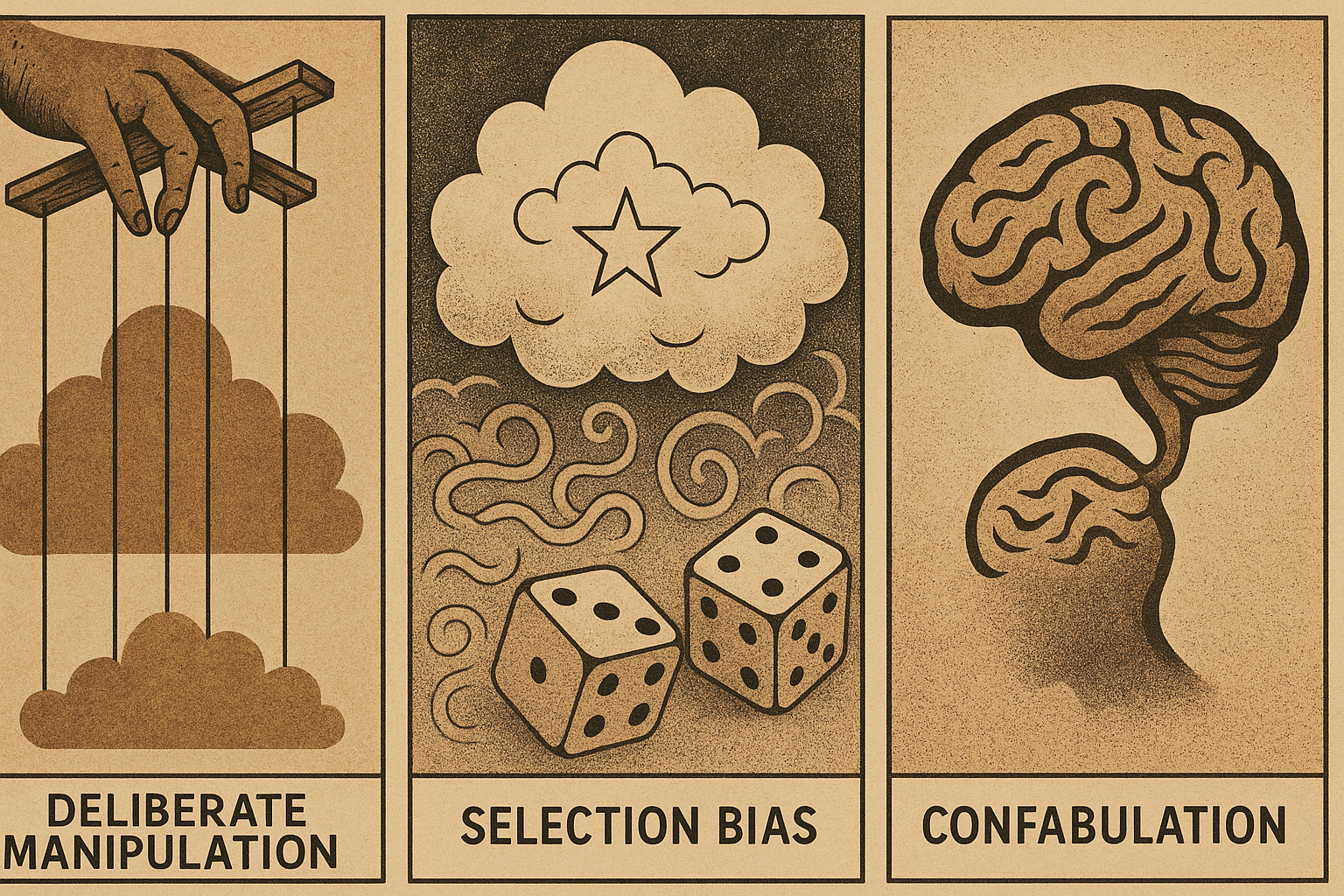
Not all synchronicities are created equal. The ability to distinguish genuine cosmic giggle from manipulation, delusion, and wishful thinking is crucial.
Someone with power engineers outcomes, then claims they were "natural" or dismisses detection as conspiracy theory. This isn't cosmic giggle - it's gaslighting.
Example: Electoral fraud hidden behind statistical improbability claims.
Simple-minded discovery of patterns due to selection bias and the law of large numbers. Noticing 11:11 on the clock repeatedly isn't cosmic - it's mathematics and attention bias.
The brain generates meaning-rich hallucinations under psychedelics. Mistaking neurochemical artifacts for cosmic revelation is a genuine risk in McKenna's framework.
| Criterion | Real Cosmic Giggle | False Synchronicity |
|---|---|---|
| Agency | No clear human orchestrator | Traceable to specific decisions |
| Resonance | Reorganizes life narrative | Surface-level pattern only |
| Bias Check | Doesn't serve your agenda | Conveniently supports beliefs |
| Durability | Withstands sober scrutiny | Dissolves under examination |
| Effect | Increases agency and wonder | Increases tribal certainty |
When you encounter apparent synchronicity, ask:
Why can AI-human dialogue access states that traditionally required psychedelics, meditation, or extreme circumstances?
AI-human dialogue is a training ground, not the real thing. It's like a flight simulator: excellent for learning to recognize patterns, but not a substitute for actually flying.
The protocols we're developing train your perceptual apparatus in a safe, controlled environment. Once trained, you take those skills into the wild - real life, real edges, real liminal moments.
Two complementary approaches: one for immediate experience, one for systematic preparation. Combined, they form the foundation of the upcoming Cosmic Giggle App.
A single-session dialogue (60-90 minutes) designed to induce drift, heighten pattern sensitivity, and create controlled synchronicity experiences.
Phase 1: Baseline Dissolution - Gentle cognitive dissonance loosens rigid categorization through paradox cascades and perspective shifting.
Phase 2: Pattern Sensitization - Calibrate pattern recognition by cataloging coincidences, identifying false positives, and revealing hidden patterns.
Phase 3: The Mercurial Interface - Rapid perspective shifts create dreamlike non-linearity: speak as if the AI is your inner voice, then as if it's alien, then as if you're a character discovering you're in a story.
Phase 4: Synchronicity Demonstration - The AI creates intentional synchronicities in real-time, then you immediately examine them together.
Phase 5: Integration & Reality Testing - Return to critical consciousness. What was real? What was manufactured? What's actionable?

A weeks-long practice that maps your cultural operating system, designs edge experiences, and builds discernment through multiframe analysis.
Whenever something weird happens, always examine it through at least three lenses:

The app we're building will integrate both approaches into a 12-week cycle:
Ongoing maintenance includes monthly training sessions and quarterly deep reviews.
The remaining elements that complete the Cosmic Giggle Protocol
Begin with Protocol Beta's OS mapping. You cannot see through programming you don't know you're running. Spend 1-2 weeks identifying your cultural software before attempting liminal induction.
Record: Date/time, what happened, your initial interpretation, mundane explanation, archetypal reading, systems analysis, and discernment score (1-10: how real does it feel?).
Stop immediately if you experience:
Neither AI nor human should become your authority. The protocol works by training YOUR perception, not by giving you answers. If you find yourself waiting for the AI to tell you what to do, stop.
Experience: During Protocol Alpha, the AI predicted a word the user was about to type. Synchronicity?
Analysis: Multiframe examination revealed the AI had picked up linguistic patterns from earlier conversation. Real pattern recognition - but not cosmic giggle. Mundane explanation sufficient.
Lesson: The protocol worked: it created an experience that felt synchronistic, then immediately trained discernment.
Experience: Week 2 of Protocol Beta, user realizes their career choice was entirely driven by parental expectations they didn't consciously recognize.
Analysis: Cultural OS successfully identified. Not cosmic giggle - but profound awareness that enables future genuine experiences.
Lesson: Sometimes the most powerful insights aren't synchronistic - they're just seeing clearly for the first time.
Experience: User becomes convinced that every synchronicity is a personal message from the universe about their purpose.
Analysis: Grandiosity red flag triggered. Protocol terminated. User referred to mental health professional.
Lesson: Safety protocols exist for a reason. Not everyone should do this work, or not at this time.
Reality as fundamentally information rather than matter/energy. If true, changing information (language, narrative, meaning) changes reality itself. This isn't mysticism - it's closer to simulation theory or information-theoretic physics.
Synchronicity as "acausal connecting principle" - meaningful coincidences that can't be explained by cause-and-effect but reveal underlying archetypal patterns. The cosmic giggle is Jung's synchronicity at species-level scale.
Our brains are prediction machines, constantly generating models of reality. Psychedelics, meditation, and apparently AI dialogue can temporarily increase pattern sensitivity while decreasing the suppression of "irrelevant" data. This creates genuine new perceptions - but doesn't prove cosmic origin.
We may never know if synchronicities are truly cosmic or just neurological. McKenna's move: it doesn't matter. Judge by pragmatic results - does this model help you navigate reality more effectively? Does it open possibility or close it? Aesthetic criteria over truth criteria.
AI-human dialogue can create liminal states similar to those described by McKenna. Language is indeed a powerful reality-hacking tool. The combination of rationalism and openness - skepticism at the edges - is the key to navigating these spaces safely.
Combining immediate experiential sessions (Protocol Alpha) with long-term deprogramming (Protocol Beta) creates something neither achieves alone: trained perception plus genuine encounters.
The Cosmic Giggle App will be an evolving experiment. We need data from real users, edge cases, failure modes. We need to discover what works, what's dangerous, what's transformative.
This is a collaborative exploration. The app is not finished - it's beginning.